Friday, July 23, 2010

Four Boys

I am teaching in the second 6-week summer session. Since this session begins right after the high schools turn loose their wards, it attracts recent graduates and dual enrollment students looking to earn some college credit before the next academic year. The students are generally good—in attitude or in skills, sometimes both. But they are so young, and their youth and inexperience always surprise me. I wouldn't want their thoughts buzzing around in my own head, I know that for sure.

Boy 1
"Can you tell me how to calculate my average?" asked Rudy, a potential 2011 valedictorian from a nearby high school. Rudy is in competition for the top honor with a number of other rivals who also have perfect GPAs. Rudy hopes A's in a couple of college courses will help distinguish him from this crowd, so here he is, slaving away at the local community college. And Rudy is making an A in my class. He is careful and competent; mechanically, his writing is flawless, though long-winded and too safe to be interesting.

My question is why would he need to calculate an average when everything I have marked is an A? Is he so competitive that he must know that he has a 99.8 in case he has heard someone else might have a 99.7? I can imagine how hard it must be to live in his head, where he constantly measures himself against everyone else. Only the numbers matter, not repartee with peers before class, not the joy of running with an idea even if it takes him over a cliff. I hope his parents would say, "We wish he'd relax." I hope they are not applauding this super-competitiveness.
Boy 2
At the opposite extreme is Paul, who refuses to accept that he's not passing the course. Despite the frequent absences [and ensuing zeros from missing work] and a steady stream of Ds and Fs on assignments, Paul keeps asking, "But I'm doing okay, right?" No, sweetheart, you're not. "What if I make A's on everything else? Then I'll be okay, right?" Perhaps, I say. But then Paul misses yet another class, and I just shrug my shoulders. I would hate that heavy blanket of denial trapping my brain.
Boy 3
In an essay, Timothy wrote, "I'm a Christian and still a vurgeon, but it's hard with all these girls and their tits bursting out of their shirts ... " A vurgeon? I wouldn't be able to spell either if I lived in a young male body unable to get any release because my religion had such unrealistic expectations of me. Timothy's Christianity requires no fornicating, but it's summer in Florida—highs every day in the mid 90s—so exposed skin abounds. This poor young man doesn't have enough of an independent spirit to disregard the rules of his religion, so when temptation finally wins, he'll have all that unnecessary guilt and self-recrimination for a biological imperative millions of years in the making.
Boy 4
Before submitting his first essay, confident Bradley told his classmates, "To make a paper good, all you have to do is add enough literary devices. They're impressive!" Bradley learned this trick in AP English, though he did not score high enough on the exam for college credit. Now he's taking freshman composition to earn those three hours. Despite his failure at the AP exam, he blindly believes what Dr. High School English Teacher has said. I'm hoping that this PhD actually taught that certain devices used with skill and care are impressive, not to hang similes at the ends of sentences like ornaments on a Christmas tree. I'm hoping that this PhD explained the value of clear communication, not faking a reader out with "devices." During one short paragraph describing his love of soccer, I learned that athleticism smiles on Bradley "like a mother on her newborn baby," that his skills get the attention of coaches "like a child grabbing a cookie from a cookie jar," and that scoring goals is "as easy as a Sunday morning breeze."

I have gotten Bradley to stop his nonsense—but only because continuing the practice negatively affects his grade, not because he believes that I have any real writing wisdom. On the first day of class, he asked, "Should we call you Dr. Lightbulb?" When I said no, he concluded that I was thus inferior to Dr. High School English Teacher.

Oh, well. Eventually Bradley will figure out that clear communication, not decorated writing, is what impresses readers. And college is, after all, the opportunity to try out new ideas and learn what works best, just like a teenage girl shopping for a new pair of jeans at the mall—ha!

Not Necessarily Laziness

I know, I have ignored this space for months. Chalk up my absence to responsibilities at my real job and that I seem capable of only one creative project at a time. I have not been out with the camera, for example, for over a year.

But I have been writing for Trade It in for Twinkies, where I have composed three new movie reviews:

And I have done four labor-intensive TV series:
But I miss writing here. Summer break is around the corner, and I hope to divide my energies between this blog and the other.

Friday, January 22, 2010

Swimming with Sharks

I just posted my review of Swimming with Sharks. Because this project is training to write reviews, I did what the professionals do and did not give away the ending.

This post, however, is not the review, so I want to talk about Guy's decision here.

>> Spoiler Alert << I believe that Buddy offers power while Dawn champions art [Michelle Forbes makes a kick-ass muse]. Guy snaps at the end of the movie because Buddy is about to fire him [= loss of power], not because he learns that Dawn has agreed to a midnight rendezvous with Buddy. Guy has already picked power over art. He breaks up with Dawn because he wants to please Buddy more than her. And we have seen him imitating Buddy's style: once on the phone in Buddy's office chair and then in the restaurant regaling the wannabes with insider stories.

For me, Guy's murder of Dawn is logical and consistent. During the evening of torture, Guy learns that Buddy lost his wife in a senseless, horrifying gang rape/murder. When Guy shoots Dawn, he is trying to prove to Buddy that he can suffer that same loss. Buddy must like the homage because he is complicit in the story he and Guy concoct to explain Dawn's death.

You can read the review here.

Friday, January 1, 2010

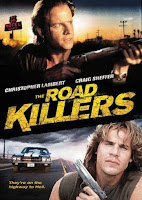
The Road Killers

The Road KillersOf the three Michelle Forbes movies I've watched and reviewed, The Road Killers is my least favorite. I wouldn't have finished the DVD if I wasn't committed to this project. I felt bad trashing a movie with my favorite celebrity in it. Everything I know about movie making I learned while watching Entourage, so I could have gotten wrong all the reasons why this movie failed.

You can read the review here.

Monday, December 28, 2009

Crumbageddon

I don't have children, so I do not have first-hand knowledge of how difficult they are to raise. I was a child years ago, and although my upbringing was painful and imperfect, my rearing was, in my opinion, better than the cushy, entitled lives I see so many children experiencing today.

The evening was too chilly to sit outside, so Elizabeth and I chose a tiny table in our favorite (crowded) Starbucks. A young couple with two children sat beside us. Unfortunately, a second glance their way revealed they were neighbors, so stupid small talk ensued. Elizabeth knows these neighbors better than I, for the mother has had to "rescue" my friend from 4-year-old Reagan, the little girl, who likes to run after Elizabeth, grab her clothes, and insist that she go into "time-out" whenever Elizabeth walks past their house. So I let Elizabeth do the talking while I sat quietly and observed the girl.

The parents had stopped at Starbucks at Reagan's request. The little girl wanted a slice of lemon pound cake, and her demand for dessert delayed four people in their evening plans. Their only purchase was the pound cake, which they handed over to Alpha Girl, who grabbed the whole slice and began eating down the center. Two towers of pound cake collapsed on either side of her mouth like the World Trade Center on 9/11. Crumbs and bigger chunks fell on the table, the chair, and the floor. When Alpha Girl had enough, her mother poked through the debris—telling Alpha Girl that she was so good to share—and gave pieces to the 2-year-old boy who crushed them in his little fist and, like Jackson Pollock flinging paint on canvas, further decorated the area. "He's much less verbal than Reagan was at his age," the father remarked, "but he's well above average!" Whatever you have to tell yourself, I thought.

A third adult joined the family, a bad-boy hipster with elaborate sideburns. Wolverine sneered at the mess and noted that they would be late if they didn't hurry up. Jackets were donned, bags and children grabbed, and then the five of them headed for the door. When the father discovered that the boy was still clutching a piece of pound cake, he slapped the kid's hand, sending a final spray of crumbs in our direction. Dad looked back and said, "I'll be right back to clean that up!" Of course, he never returned.

I know that wiping tables and mopping floors are responsibilities of the Starbucks crew, but I was appalled that three adults felt entitled to leave a table that messy. New arrivals couldn't sit there unless they took on the job of cleaning up the disaster these assholes thoughtlessly made. Elizabeth and I were stuck looking at it, and, because we had been talking to them, were getting looks from other patrons as if the eyesore was our responsibility.

As a child, I would have loved parents who always let me have my way and who held me accountable for nothing. I can only imagine how much my confidence would have grown if my desires and happiness made a difference to Mom and Dad. I couldn't get my parents to stop to let me pee—"Hold it until we get home," my father would have growled—let alone divert them for food I alone desired. My parents would never have allowed me to make such a mess in public; I remember orders to brush the salt grains off Burger King tables so that the minimum-wage staff wouldn't think my family and I were pigs. As a result of my raising, I know that I am not the center of the universe, and I am glad that I learned that fact early. I feel sorry for Reagan, who might have alpha status right now but will learn soon enough that the rest of the world won't cater to her whims as Mom and Dad do.

Wednesday, December 16, 2009

Kalifornia

KaliforniaI just posted the review for Kalifornia. I remember seeing this movie in the theater when it first came out. I went for David Duchovny as I was a big X-Files fan. I remember that I found it very disturbing, but I don't recall if what bothered me was the violence or Brian Kessler not being Fox Mulder enough.

I was not looking forward to seeing the film again, but 16 years later—this time studying a different character as the action unfolded—I really enjoyed it. I like movies that show we are not affixed to one place on a continuum like violence. Sure, Early is at one extreme end, but he moves more to the center when he pistol whips Brian instead of shooting him and then handcuffs Carrie to the bed instead of killing her after she embeds that shard of glass in his side. Brian and Carrie—both at the opposite end of the continuum since they have never held guns, let alone used them—have to slide over to violence if they hope to survive. The movie is an interesting study in adaptability—Early who tries to adapt to friendship, Brian and Carrie who have to accept their animal instincts.

You can read the review here.

Sunday, November 29, 2009

Love Bites: The Reluctant Vampire

I have begun a new project which, at this early stage, seems intimidating and impossible: I am going to review all of the work of the actress Michelle Forbes. [I will berate myself less for the silliness of a celebrity crush if I can point to the hard work of analysis and writing that these reviews will require.]

After much difficulty, I finally tracked down a copy of Love Bites: The Reluctant Vampire and composed my first movie review. I think this one is too heavy on summary; I'll try to be more careful of that problem with the next film.

You can read the review here.

Tuesday, March 24, 2009

March Madness

As the tales below will illustrate, I have hit the point this semester where I just don't care any longer if I lose a teaching moment.

Right before the withdrawal deadline, I make my students do an admittedly corny in-class assignment which I call The Midterm Reality Check. They fill out a form to determine their current average and write a paragraph explaining what they will do to maintain or improve that average by semester's end. When a student says, "Professor Lightbulb, I can't find Reading Quiz 3," I get to say, "That's because you weren't here the day we took it, so put a zero in the box," demonstrating to the entire class the correlation between attendance and success. I like making students do the math themselves rather than bugging me with a "How am I doing in this class?" I like having the bad students reflect on what behaviors got them into their pickle; I like letting the good students with high marks in all their boxes watch the bad students scramble to make the math work in their favor.

Bryan, always the first to finish—but also the most likely to lose significant points for failing to follow directions—brought me his form, ready to escape the prison which is my class. His average thus far was a 63. I said, "Thanks" and let him go. I should have pointed out that his desire to rush out every day contributed to his low number, but I didn't.

Back in my office, I found an email inbox full of messages, two of them from my most frustrating student, Roderick. This young man is empty handed when work is due, but excuses tumble out of his mouth like presents from Santa's sack. The first email asked for a letter of recommendation for a scholarship. Roderick is not empty headed; he is bright and creative, just undisciplined. I could frame him as full of potential in the letter I was considering writing. A few more messages down the list, I got Roderick's second email, this one explaining that he would be missing yet another class for another unbelievable reason. I returned to the first email to say that I don't write letters of recommendation for students with F averages. I should have explained that the deciding factor was the second email with yet another lame excuse for his missing warm body and/or homework, but I then asked myself, Why bother?

Later that day, I sent midterm averages to my online students. Katherine wrote back to protest a zero. She claimed that she did in fact post a response to our first cyber discussion. I checked the board but found no post. I looked for the automatically generated email copy that the service sends when a student hits "Submit" but found no email. I searched her virtual folder for the .doc copy she was supposed to send "just in case" but found no copy. I wrote back that I had no evidence of the missing work, so the zero would stay in my gradebook.

Oh, claimed Katherine, it was saved on her home computer. She couldn't understand why I didn't have it. Of course, she neglected to send this "saved" copy with her protestation, for she won't actually write it unless I ask to see it. I explained that I do not take discussion responses late, and the zero would stay.

You're being so unfair, Katherine replied. Why, she even sent a draft of her discussion response to her aunt to proofread, and the timestamp on that email showed that she had written it before the deadline. She did not, however, forward this sent email to me and missed a third opportunity to send me her "saved" copy.

I held firm. Zero, Katherine. Part of me wanted to explain the strategies that she could have used to make her story more believable. For example, she could have inquired about this January assignment in early February: "Professor Lightbulb, when am I getting a grade for the first cyber discussion?" I would have scrambled to find it, assuming that I was at fault and taken anything she sent. Or she could have written it and attached it to the first email, hoping that if she immediately produced the work I would believe it was written long ago. But waiting for a cue that I would accept it before she even bothered to write it was misplayed. I hate when students lie to me and refuse any grace in such situations. I wanted to write, "Katherine, sweetheart, I have taught college longer than you have lived. Such amateur tricks don't work on me," but I was too over it all to bother.

Friday, March 6, 2009

Beautiful Boring

As soon as my online office hours were over at 11 a.m., spring break began! Elizabeth and I made our second trip to Lukas Nursery, where she bought more plants, and I spent time with the flying beauties in the Butterfly Encounter. I don't want to become a boring one-trick pony, but here are the latest takes with the camera:

Swallowtail, probably black
Click photo for large version.

Painted Lady
Click photo for large version.

Giant Swallowtail
Click photo for large version.

Julia Heliconian
Click photo for large version.

Wednesday, March 4, 2009

Evolution of My Grading

As an undergraduate, I worked in my college's writing center where I learned to mark student essays in a manner that inspired thoughtful revision. For example, my tutor training taught me to ask questions instead of bark orders—"Can you tell a specific story to illustrate this?" rather than "Give an example." Because I worked one on one with just a handful of students per day, I had time to evaluate their writing in a meaningful manner.

When I got my first real class to teach—one section of prep writing as an adjunct—I still had time to comment in ways that I hoped inspired improvement. But as my dean concluded that I had "the gift" and began giving me more and more classes, and then a temporary full-time contract, and then the coveted tenure-track position, I could no longer comment as carefully on the work of 150 students, each of whom had to write 6,000 words per semester, a state mandate.

My grading changed from thoughtful remarks about content to covering my ass by marking sentence errors. I believed this strategy was necessary because of the precariousness of my employment. In those early days, I quickly learned that students shared their papers with everyone. As a result, I began to mark essays so that if a senior colleague or my dean got his hands on the paper, he would know that A) I read the entire essay, and B) I knew my grammar. Another factor influencing the number of sentence errors I marked was the do-or-die, department-graded final exam. At the time, the college required that freshman composition students pass this final exam essay or fail the entire class. The most common cause of failure was too many grammar mistakes, especially when a paper indicated a lack of fluency with English. So I marked every sentence error—top to bottom—in the essay; if a Korean left out articles, I added ^a, ^an, or ^the wherever necessary. No student could complain, after receiving a semester's worth of papers dripping with green ink, that she didn't realize that she was in jeopardy of failing the class heading into the final exam.

Once I was awarded tenure, new responsibilities and observations affected my grading. Freedom from paranoia didn't turn me into a lazy grader who didn't really read, nor did I become a hardass no longer concerned if students complained about my unreasonable demands. Instead, I began loosening my standards, mostly as a result of the hypocrisy my colleagues demonstrated.

I first learned that my classroom expectations weren't in line with the reality of academia when I began editing a professional journal showcasing the interests/research of the college's faculty and staff. Before this experience, I was really nitpicky about works cited page entries/parenthetical references in student essays. Because my students and I had a lengthy discussion/practice of how to compose works cited page entries and the corresponding parenthetical references, I took 2 points for every error I found in the final document, no matter how small. A miscapitalized word, a missing mark of punctuation, forgetting the brackets that enclose the web address—minus 2 points, minus 2 points, minus 2 points! I could get an essay down to a 70 on the works cited page alone. But after reading submissions from PhDs who made up their own personal citation style as they wrote—which then required extensive changes from me and the other editors—I decided I wasn't going to bust first-year students so harshly for something that their professors couldn't do correctly themselves. If the list of sources looks works cited page-ish, I'm okay with it now.

I am crystal clear about what plagiarism is and my penalties for it. Those penalities, however, have lessened over the years. In the past, if a student lifted a single sentence verbatim from a source and neglected to include quotation marks around it—whether or not a parenthetical reference followed—she earned a zero. A second instance meant I WFed the student from the class. Not so any longer. When I heard a colleague bitch that the papers she wrote for her daughter's college history class were earning only B's, I quit losing my temper over plagiarism. How could I bust students for doing something my fellow faculty—as well as more prestigious teachers at better schools—did without real penalty? A lifted sentence without quotation marks is just a punctuation error for me now.

I used to agree with my colleagues that too many errors—no matter how intelligent or insightful the content—equalled a failing paper. Then I began to serve on faculty hiring committees where candidates had to write impromptu essays right before the interview. Some of these pieces were grammatical disasters, but I would listen to faculty who argued that we should overlook the mistakes, especially if they really liked a candidate. "He was nervous," "Twenty minutes is too little time to write and proofread," or "She is very good with students" were some of the excuses I heard when committee members wanted to move a candidate to the second interview with the provost. Then when our Chief Learning Officer sent an email introducing a new hire as a former principle of a local high school—for even she didn't remember that your principal is your pal—I gave up. I'm not failing students for making mistakes at the beginning of their higher education that folks with advanced degrees can't handle themselves.

If you get a group of faculty together in a room, they will insist that they are, by god, upholding standards. They will bemoan the fact that students today can't do things they themselves did stupendously back in the day. Anyone listening should have plenty of skepticism, though. Most of those faculty have skills only slightly better than the average first and second-year students in their classes.

I still give plenty of Ds and Fs as final grades, but those students don't pass because they either A) can't follow simple directions, usually because they didn't attend class to get them, or B) can't get the work done at all. Skills like documenting sources, avoiding plagiarism, and editing for sentence errors are not what get the students in my classes in trouble.

Monday, March 2, 2009

When Things Work and When They Don't

Our favorite barista invited Elizabeth and me to meet Howard Schultz, the CEO of Starbucks. He is, we learned, visiting individual stores all over the country, talking to patrons, trying to determine what can be done differently/better since the current recession is the first time in Starbucks history when profits/growth have declined. Any caffeine fiend without a special invitation had to peer at us through the plate glass as the staff served custom drinks in ceramic mugs and slices of cake decorated with whipped cream and cut flowers. When Mr. Schultz asked for feedback—either positive or negative—the invited guests offered praise and complaints. I enjoyed watching a billionaire honestly engage his customers. He admitted when he thought the company made mistakes; he talked with great passion about health coverage for his employees and ethical farming. He was nothing like the banking and automobile execs dodging questions before Congress.

One story he told got me thinking. During a recent visit to New York City, he walked into a filthy Starbucks. He explained that the mess wasn't the result of a busy lunch hour when the employees were too overwhelmed to keep up with cleaning. No, this filth was established. He then bemoaned the difficulty of finding store managers with the leadership skills to run each individual location in an ideal manner. We could all relate. Throughout my city are Chick-fil-As and Burger Kings that I refuse to enter, and yet I know individual stores where the employees keep the tables shiny and the fries hot.

Unlike Mr. Schultz, I think a well-run store is not entirely up to the manager, that location and the corresponding clientele make a difference. When a number of guests bitched about the Starbucks near the university, several people noted that rude workers staffed every food and beverage location in that area, that students serving—for the most part—other students were bound to be surly. Elizabeth and I once ordered coffee from the Starbucks at the Florida Mall. The store was a pigsty; we watched unoccupied employees ignore the mess. We surmised that the store atmosphere which we so prized at our regular Starbucks could not develop in a location where tourists visited a single time, and the lack of intimacy affected the attitude of the employees.

In the classroom, student mix can handicap an otherwise effective professor in the same way. I have gotten enough feedback—on classroom visits by the dean, on student evaluations, in comments at RateMyProfessors—to know that I am a good teacher. But my classroom leadership skills do not mean every section of a class goes equally well. I can adjust my methods so that if I have a really extroverted class, I tone down my own enthusiasm to keep the top from blowing off, and if I have a reticent class, I have a few tricks to get the reluctant participating. Even so, some classes, despite what I try, fail to respond, and four, five, six weeks into the semester, I give up on ever enjoying them; I count down the days until final exams.

This semester, I have thrown up my hands in one section of freshman composition. On Mondays and Wednesdays, I have a group I love, whose papers I enjoy reading. After grading a set of essays, I pick out the four best titles, the four best thesis statements, the two best introductions, and read them aloud; then I let students vote on which ones they like the best, rewarding the winners with candy bars purchased from the book store. The class has gotten very competitive composing those introductory parts of an essay where the writer grabs or loses the reader's attention. Does the other class get candy? No way. The students are cowardly automatons, afraid to have an original thought that might distance them from the safety of their boring peers. For them, I bring grammar worksheets. And if I were Howard Schultz and they were one of my Starbucks stores, I'd immediately close the doors and lay off the workers. Unfortunately, I'll still be serving up composition instruction every Tuesday and Thursday until late April.

Thursday, February 19, 2009

Letter to a Student

Dear Mr. Too-Cool-for-School:

This admission might surprise you, but when I was an undergrad, my classes frequently frustrated and bored me. Like you, I often sat in class without taking notes. Like you, I seldom had my work done on time.

Our similarities end there, however.

Unlike you, I didn't sit angry as a storm cloud, glowering, arms crossed, radiating negativity that filled my corner of the classroom. My demeanor indicated interest—even on the days it was feigned—so professors found me attentive and polite and were willing to give me a little grace when I missed an exam or deadline.

Unlike you, I have an excellent memory. Not only could I remember everything the professor said during a lecture, but I also remembered all of my own musings—the connections, consequences, and applications of the material covered in class. So when I had to write an essay or take an exam, I didn't regurgitate my fuzzy, superficial understanding of the lectures. I had instead substantive, insightful things to say, further winning me points with my teachers.

Unlike you, I was such a good writer—a reputation that often preceded me—that professors would say, "Give me the paper next week, Sparky. Your essays are always worth waiting for." Unlike you, I almost always earned As. And when an iron-willed instructor got tired of my attempts to bend the rules and refused any more grace, I recognized that I was at fault and accepted the punishment. Unlike you, I didn't have tantrums appropriate for two year olds during which I blamed the professor, the computer lab, my frozen water pipes, etc. for my own shortcomings.

I've read your essays and observed your attitude. You're perfectly capable of college-level work, but you're no great talent. I assume that your parents did let you in the house, but you act as if they kept you out in the barn, behavior that doesn't inspire any grace from me. This means that you have to do things on time, based on the lectures given in class. So you might want to pick up that pencil and start writing things down, for you will never hear me say, "It's okay, Mr. Cool, I'll take that assignment late. I'll use the extra week to let my anticipation build for what will inevitably be a great essay!"

Yours truly,
Professor Lightbulb

Monday, February 16, 2009

Swagger Jacking

My freshman composition students are drafting their definition essays. As they were choosing their topics—they have to define a type of person—I encouraged them to bring something new to the table. When I asked for possibilities, one of my students offered "swagger jacker," a term I had never heard. The student explained that a swagger jacker hijacked someone else's swagger, or style. I was delighted with the name.

When I saw Elizabeth later in the day, I asked her if she knew what a swagger jacker was. She did not, so, puffed with superiority, I defined it.

"So you swagger jacked CJ?" Elizabeth asked.

Alison Janney/CJ CreggYes, it's true. For years my style had been boring but my own: neat but casual, too much 100% cotton, everything fit for a washing machine. But then last summer, I began watching all seven seasons of The West Wing on DVD, a show I missed during its original run. CJ became my role model for dressing. I liked the masculine suits softened with colorful collared shirts, camisoles, and jewelry. I decided that at 45 years old, I should own suits of my own, and have since bought four with shoes to match. When classes started this spring, I wore a new suit each day the first week. CJ's style is classic, so I can keep it for the rest of my professional life. The West Wing premiered in 1999, but I heard that the office staff reported to my dean, "Damn, Professor Lightbulb looked good" when I wore the taupe suit on Monday.

Now that I've 'jacked a TV character's style, I guess I'll have to be less critical of the colleague who roams the hallways dressed as Brittany Spears circa "Hit Me Baby One More Time" or the one who exits his ordinary little Toyota dressed as a Hell's Angel—black motorcycle boots, black leather jacket, wallet secured with a chain to his faded jeans, unshaven face and pony tail. We're all being someone else.

Friday, February 13, 2009

New Beginning

A student approached me after class the other day to ask, "Do you post as Sparky Lightbulb?" I said no, and at the moment that I responded, I meant it. Then I remembered that I used to blog—as Sparky! Oh, no! Students had learned my secret identity! Oh, no! What information that I didn't want to share had they discovered?

I signed into my Blogger account ready to "draft" any embarrassing posts—if not delete the entire body of work—but I discovered that this blog is a charming snapshot of my life two years ago. So what if a person who knew me as Clark Kent got a little insight into my Superman?

Rereading some of the posts here reminded me how much I enjoyed blogging—as well as photographing, something else I've essentially abandoned as my work life and other projects swallowed up my time. I dusted off the camera, and, in search of a sure thing, drove to the Lukas Nursery Butterfly Encounter, where I shot those proverbial fish in a barrel:

Sulpher, possibly a Large Orange
Click photo for large version.

Malachite, native of South Florida
Click photo for large version.

Zebra Longwing
Click photo for large version.

Julia Heliconian, perched like a bat
Click photo for large version.

Atala, another native of South Florida
Click photo for large version.


I had so much fun that I might just have to dust off the Spandex and cape, ready to soar through cyberspace once again!

Thursday, May 31, 2007

Bzzzzzzzzzz

I cannot let May 2007 end without a single post here. I haven't lost enthusiasm for blogging; I just don't seem to have any time! I did go out with the camera last weekend and noticed [in a completely unscientific way] that the insect population—butterflies, dragonflies, and bees—was less abundant than this time last year.

The weather, though, is different, much drier than last May. The Old Farmer's Almanac says that Florida will have a wetter than usual June, so I am hoping that thriving wildflowers and higher humidity will fill the air with my little friends.

Carpenter bee

Sunday, April 29, 2007

Spending Time with the Small Things

I spent two hours at Mead Garden today, sweating in the already hot sun and pursuing little things with the camera. A woman walking her Great Dane warned me to take care near the water as she had just seen a large water moccasin, but I had my doubts, what with all the elementary kids who visit the park by the busloads.

The male anoles were flashing the females everywhere I turned:

Brown anole
The dragonflies were back in force, especially blue dashers:

Blue dasher
Even though I have photographed hundreds of blue dashers, I still enjoy them. The photo below I might use as a Christmas card for 2007, a weird little angel perched atop an equally weird little tree:

Blue dasher
Blue dasher
I also shot a gray-green clubtail, Arigomphus pallidus, another new species for me. Clubtails are not handsome dragonflies, but I always enjoy spotting something new.

Gray-green clubtail
And the male pondhawks were dueling with the blue dashers at the water's edge. I never got a good picture of one last year; this shot isn't stupendous, but it's an improvement over my sorry efforts from 2006:

Eastern pondhawk male
I had a lot of fun, but a big project is taking up my time, and I don't know when I'll get the chance to go out again.

Sunday, April 8, 2007

Photo Lesson

Today I learned that the hostess, anxiously preparing the Easter feast, is never happy to discover that a guest is dissecting the tulip centerpiece and snapping pictures:

Tulip center

Sunday, March 18, 2007

Shooting Fish in a Barrel

Lukas Nursery has a "butterfly encounter," a large enclosure stocked with nectar and larval plants and hundreds of free-flying butterflies. The captives are so tame [or depressed] that they tolerate very close human proximity. Species like the zebra longwing, which I have chased without success at Leu Gardens, will perch on the end of a human finger. So I thought that taking great photos would be as easy as shooting those proverbial fish in a barrel. After dumping the day's haul onto my computer and viewing the 150 shots, I learned otherwise.

I blame my macro lens, which I used exclusively, although I realize that my amateur status as a photographer was more likely the real culprit. I always aim for the eyes, and since the macro lens has such a small area of clear focus, I got lots of super-sharp butterfly eyes while the rest of the insect was reduced to blur. Below are some of my nicer efforts.

A Great Southern White:

Great Southern White
Julia Heliconians:

Julia Heliconian
Julia Heliconian

And Zebra Heliconians:

Zebra Heliconian
Zebra Heliconian
I'll bet that shooting real fish in a barrel isn't as easy as one might at first think!

Tuesday, March 13, 2007

Spring Break Adventure

Elizabeth and I spent the day at Moss Park. I had hoped for lots of dragonfly photo opportunities but was disappointed by the small numbers of insects in inconvenient places. Moss Park has big areas of water, and alligator breeding season is right around the corner, so I was sticking to the shores heavily trafficked by people and boats! I did manage one shot of a cypress clubtail, a new species for me:

Cypress clubtail
And another shot of a sandhill crane pair:

Sandhill cranes
I am definitely feeling out of practice with the camera!

Thursday, February 15, 2007

Good or Cool? What's More Important?

"This is from the heart," Raj insisted, tapping his chest. He was explaining why I was the finest instructor at the college. I listened patiently, uncomfortable with the gush of praise delivered in the hallway. I didn't want to hear that I was "so unlike" the other, presumably bad professors that Raj had taken after his semester of freshman composition with me.

I am not so modest that I can't listen to compliments. The problem was that Raj was the student delivering them.

Raj is Indian or Pakistani, older than I, probably in his late 40s or early 50s. He already has a university degree from his home country, one that isn't honored here in the States, so he has returned to school to pursue the credentials that will allow him to work again as a pharmacist. When Raj was in my class, he was a model student. He was smart, punctual, and prepared. He understood social hierarchies and respected them, beginning each question he asked with a British-inflected "Ma'am." But Raj was far from cool, and his comments bothered me that day in the hallway because he had caught me right after a class with the Show Dog.

The Show Dog is tan, tall, and surferesque but not a surfer. I can tell that his dedication is to the stylist who can streak his hair so beautifully, not to the next wave. He exudes wealth—and not from parents strapped with huge credit card debt who buy him whatever he wants as bribes. No, his parents have real money, and lots of it. I just know that he drives a much more expensive car than I do, and he knows it too.

I assume that he is taking freshman composition in the spring because he flunked out of an expensive 4-year school last semester, probably after four months of heavy drug and alcohol abuse. He has that world weariness that comes from too much high drama early in life. I'll bet that his parents want him close to home so that they can easily return him to rehab, if necessary. Respectable grades during a semester at the local community college might be all the university needs to readmit him next fall, what with the endowment Dad has promised.

The Show Dog is a decent writer but has no interest in improving his skills. He never says a word in class, yet everyone is aware of his presence and behavior. He won't take notes. He sits the entire hour and fifteen minutes with his arms crossed, awake but bored. He is not sullen, just passively tolerating the restrictions on his freedom. Usually when a student doesn't participate—doesn't talk, doesn't take notes, doesn't do the optional bonus-point assignments—the others in the room dismiss him. Their suspicions that the nonperformer is a loser are confirmed when I return heavily marked essays or low quiz scores.

But the Show Dog is so charismatic in his wealth and ennui that I notice my good students mimicking his behavior by putting down their own pens and attempting to replicate his inscrutable face. The Show Dog isn't instigating this minor rebellion—I can tell that he finds all of us so beneath him in money and experience that we hardly register—but my students act as though they are in the presence of a celebrity, and the only way to get his attention is to imitate him.

Now if the Show Dog had stopped me in the hallway to praise my teaching, I would have enjoyed the compliments—although such behavior certainly isn't the Show Dog's style. If I just caught the corners of his mouth upturned in the start of a smile during one of my witty moments in class, that would do. But my humor must be so unsophisticated or safe by the Show Dog's standards that I can't break the stoic blankness of his features.

And here's the self-revelation I'm not much liking: It doesn't matter to me that hardworking, good Raj, whose life has been nothing but challenges and obstacles, appreciates my style and skill as a teacher. I would rather have confirmation that the pampered Show Dog thought I was cool.

Maybe I know that the Rajs of the school are easy to impress; they require only that I have a professional demeanor and an organized class. The Show Dogs, meanwhile, need a level of hipness that I no longer have [and maybe never did]. I don't believe that I will ever get this Show Dog to connect with what I'm doing in class. His refusal to meet me halfway—something the Rajs are all too happy to do—is part of the problem. But that I wasn't able to spark an exception from him means that I am getting too old or too tired to be good and cool.