Monday, April 10, 2006

The Eyes Have It

Why am I taking pictures of bugs? Sometimes a photo outing is a scavenger hunt. I know a certain species exists in my area—the field guide says so—and I want to find a member and prove that I did with a picture. Often, though, I will chase after another white peacock [my favorite butterfly, even though they are quite common in Florida] or a monarch [my least favorite], hoping for a better shot of the eyes. Insects might be ambulatory vegetables, allowing purely instinctual impulses to influence their behavior, wind-up toys running until their springs loosen. But when I capture their eyes in just the right light, I can give them impish or serious personalities that make them look like great [or at least cunning] thinkers.

And more than we realize might be happening in their little heads. I'm currently reading Life in the Undergrowth; its author, the naturalist Sir David Attenborough, points out that scientists have long considered insects "automata, mindless robots reacting automatically to the simplest stimuli," that crediting them with any of our human motives was thought "unjustified and scientifically disreputable anthropomorphism." Recently, however, scientists have begun to revise that attitude. In an experiment recounted in An Obsession with Butterflies: Our Long Love Affair with a Singular Insect, swallowtail butterflies learned to revise instinctual behavior to survive. Lantana, a common nectar source, "signals" butterflies, one of its pollinators, with color: a yellow bloom likely holds nectar while an older, red bloom does not. When scientists drained the fresh yellow blooms and filled by hand the red blooms, the swallowtails didn't starve to death as they would if they were simple "machines" obeying pre-programmed commands. Instead, they overrode their instinct, tried the red blooms, and were rewarded with food. They had learned that their instinctual preference for yellow wasn't feeding them and found a solution for their hungry bellies in the red.

When I look at field guides, the pictures often capture butterflies, for example, from behind, like this:

White Peacock, from behind
I can study the wing patterns and figure out a species identification, but I get no insight into the insect's attitude. To me, this kind of photo is equivalent to knowing a stranger as he drives by in a limousine with tinted windows. Oh sure, he might be a big-deal movie or rock star, but even though I saw the limo pass, I have no personal knowledge of the man inside, as I would get at a superficial, shake-hands-and-gush backstage meeting.

That's why I prefer a head-on shot, one that lets the little bug stare right back at the lens, giving me a little attitude.

White Peacock, head on
Sparkle in the eyes is also important. My newest lens, a 300 mm, allows me to sit six or seven feet away from the subject. This distance provides enough cushion between us that the creature won't try to scurry away or hide. I can relax and take several pictures as my subject goes about its life. With luck, I'll catch the wet or shiny part of the eye at just the right moment, humanizing the little guy.

Green anole
Honey bee
A butterfly or lizard on the computer screen is huge; in real life, many of my subjects are the size of a quarter or the first two digits of a finger, their little eyes difficult to catch. A slight shift of the lens or the subject [I breathe; the wind blows; the subject spies food or a predator] and the point of clear focus will become a shoulder or front leg, not the all-important face. For me, a successful picture is the capture of an intelligent eye staring right back at me.

Roseate skimmer
Red Admiral
In real life, the subject cannot hold its gaze with the same unwavering intensity of a photo, but engaging my eyes with its own gives the subject an upfront honesty that intimates an intelligence that I enjoy experiencing.

Wednesday, April 5, 2006

Little World, no. 1

Bee in cloverWhen I was an invincible teenager, I used to walk barefoot around the neighborhood lake. One time I stepped on a rusty fishhook someone had carelessly discarded. Sometimes a foot landed in dog poop or on a mound of fire ants. And on one occasion, while strolling through a patch of clover, I got stung by a bee.

My neighbors consider clover a weed, although it is possible to buy seeds online and plant them as ground cover. I understand why people pull this plant from their lawns. The leaves are nondescript, and the flowers, viewed from eyes five or six feet off the ground, are nothing special: yellowish white puffballs that brown with age, colors reminiscent of used cigarette butts.

Clover bloomThe first time I tried my newest camera lens, a 300 mm, I was shooting anything that caught my eye, not at all attempting to make "art." I took several shots of the puffball flowers in a clover patch. After dumping these images into the computer and viewing them, I was mightily impressed with the intricate petals that fell away from the centers, row by row.

Bee in cloverI noticed also that a patch of clover, so inconsequential to me, was a tiny world full of activity. Bees, for example, visited flower after flower collecting nectar and pollen, like migrant workers harvesting fruit in strange groves.

I can't count the times I have stomped through clover—now with feet safe in shoes—while walking the dogs. I don't know how many tiny creatures I have crushed underfoot after Yo-Yo or Bug has dragged me off the sidewalk to one more interesting spot to sniff.

Bee in cloverI do know that if I sit quietly by a patch, I will soon notice movement as this little nectar oasis teems with tiny life. I can take a vacation from my giant world to visit a different country, one without UN representation. I get to experience a culture that I don't understand, its citizens speaking and behaving in ways I can't translate with accuracy.

Bee in cloverI have friends who are constantly traveling: Germany for spring break, Miami for a conference, New York City for technical training. Part of me feels that I miss something by not leaving home more. And yet when I am visiting a little world underfoot, I do vacation from my everyday life and sample a new culture. Plus I have the travel pictures to prove it!

Thursday, March 23, 2006

Fanconi Syndrome, Part 6

A couple of weeks ago, Yo-Yo and I returned to the specialist for follow-up blood work, as per Dr. Gonto's Fanconi syndrome protocol. Based on the results, Dr. Skeptical has increased Yo-Yo's sodium bicarbonate dosage from 8 to 10 pills per day. Apparently her carbon dioxide level [pCO2] had dropped to 33.3 mmHg, but her pH reading was more alkaline at 7.323, up from 7.252. I was hoping to hear that we wouldn't have to return for six months to a year, but Dr. Skeptical wants to run Yo-Yo's blood again in 3 months. She also confirmed my suspicion that Yo-Yo will need an ever increasing amount of sodium bicarbonate until she is taking 32 pills a day, the maximum dosage on the protocol.

This visit was much more pleasant than the first. The clinic was on schedule, so we were seen immediately. I knew what to expect and felt less anxious [Yo-Yo, however, expressed her dissatisfaction by peeing under the exam room bench]. Dr. Skeptical was in a much happier mood and didn't dis the protocol as she had at our last visit. We even had a laugh inventing the circumstances necessary to perform a double-blind study to test the protocol's effectiveness. On a secret island, researchers would establish a colony of 1,000 basenjis, fed by assistants who were paid to do just that, provide sustenance, not get attached as regular owners would. Then, after the 10 percent developed the disease, the other 900 could go up for adoption [Wouldn't the national rescue group love that!]. The remaining 100 would participate in the research. The only problem, as I pointed out, was that basenjis could win over even hardened scientists who, as a result, would start sneaking sodium bicarbonate to the "sugar pill" group anyway!

I decided to spring for the very expensive ultrasound [$270], just so we would know early in this "adventure" the state of Yo-Yo's kidneys. Dr. Skeptical sent Elizabeth and me away for an hour, and Yo-Yo went to radiology, where she received a Brazilian wax before the procedure. Elizabeth and I drove up the road to Quiznos, and since the restaurant was in a Publix shopping center, we got Yo-Yo a quarter pound of roast beef to make up for the stress of the afternoon and the sandwich stink on our breath. When we returned, Dr. Skeptical had a laptop loaded with pictures of Yo-Yo's insides. Her kidneys are normal size, but the ultrasound showed that her bladder wall was thickened, indicating an infection. There was no blood in her urine, though, and at the last visit, her culture had been "clean." Her walk behavior didn't indicate an infection, either. We stopped to pee just once; if she found a really interesting street corner, she might squeeze out a few extra drops for any other dogs that happened by. Dr. Skeptical decided that we would culture her urine again at the next visit and see what happened.

Elizabeth unwrapped the roast beef, and Yo-Yo gobbled a slice. Elizabeth gave the second slice to Dr. Skeptical, who tore it into little pieces. In typical basenji fashion, Yo-Yo accepted the offerings—it was roast beef after all—but remained aloof to her "torturer." She acted as if Dr. Skeptical's hand was the floor, and she just happened to find bites of beef there.

Yo-Yo still looks good, has high energy, and is her usual spunky self. An extra meatball with breakfast and dinner to accommodate two more sodium bicarbonate pills suits her fine.

Thoughtful Yo-Yo

Yo-Yo considers whether or not she will forgive the trip to the specialist.


The camera loves me.

Yo-Yo knows how cute she is.


Shy Bug

Not another picture, Ma!

Saturday, March 11, 2006

Finding Nemo and the Hero Cycle

Finding NemoOnce again, my students and I satisfied the literature portion of the research course using Joseph Campbell's story rubric as our focus. To evaluate everyone's understanding of the hero cycle, this semester I showed Finding Nemo instead of The Matrix, the tried-and-true film I have used previously. Finding Nemo has several advantages: it is approximately 100 minutes, so even though we broke for discussion at four places in the movie, we still saw the whole thing during two 75-minute class meetings. Second, I didn't have to ride the volume command as there are fewer scenes that will inspire an instructor next door to ask me to reduce the noise—no gun battles, no explosions, no screaming subway trains. Plus, all of those overprotected, closed-minded religious kids can't complain as it is a G-rated movie. The nice thing about a Pixar choice is that there are enough references to adult concerns that the students don't think the movie is totally unhip; Bruce and his shark boys, for example, are in a 12-step program for "substance" abuse.

We managed to get Marlin through 16 of the 17 stages. The only one we missed was "refusal of the return." Since the movie so abbreviated the return portion of the cycle, we concluded that Marlin probably satisfied this stage as well, but the scene didn't make the final edit. When I have time to watch the movie again carefully, I'll follow Nemo more closely and see if he too goes through all seventeen stages.

We broke Departure down like this:

Call to adventure: Nemo disobeys his father and swims past the drop off to inspect the boat. This scene should inspire Marlin to leave the reef and venture into the open water.

Refusal of the call: Marlin attempts to order Nemo back but refuses to follow his son past the drop off.

Supernatural aid: The scuba diver nets Nemo, the goggles with the Sydney address the "amulet" Marlin needs to start his adventure. [Many students wanted to use Dory as supernatural aid, as she guides and advises—such advice as it is—our hero throughout the adventure.]

Crossing of the first threshold: Marlin makes his ineffective dash after the boat carrying his captured son.

Belly of the whale: Marlin finds himself out in the ocean proper, far from the comforts and familiarity of the reef.

Meeting with BruceAfter our discussion of Departure, I turned the movie back on and let them watch through the encounter with the sea turtles. After this portion of the film, we decided that Marlin had three major challenges during his "road of trials," the first stage of Initiation. He learns how to deal with the new denizens of the open ocean when he and Dory encounter Bruce, the great white, and the other shark boys. The anglerfish and then the school of jellyfish teach Marlin about the dangers past the drop off. I challenged the students to find another series of three, but most of them could only pick out one or two more. Since I used the scuba diver as supernatural aid, I believe Marlin's first "trial" is learning to make sense of the illogical Dory. Another one that the students tended to overlook was escaping the tottering ship that almost crushes Marlin and Dory right after they escape the sharks—perhaps because they lumped this scene into the trial of the sharks. The smart-ass school of fish, another communication challenge, made a total of six for me.

"Well, what if you ask us about road of trials on the exam?" asked one student who couldn't come up with six.

"Then you say something like, 'Road of trials is a stage that typically comes in series of three. Marlin faces many trials during his adventure, but the three most important ones are A, B, and C.'" Most of them just don't know how to manipulate the evidence to make it look as if they know more than they actually do, and sometimes I feel like a used car salesman explaining how to spin the material to their advantage.

Meeting with CrushWe decided that Crush qualified as "meeting with the goddess," the next stage of Initiation, even though he was male. His emphasis on parenting made him, in our minds, feminine, and his advice about giving children independence seemed the key lesson Marlin needed to learn to complete the adventure successfully. I had primed them earlier in the unit for considering a male character as feminine. During the hero cycle lecture, we viewed a clip from Return of the Jedi when Darth Vader and the Emperor try to tempt Luke to the dark side of the Force. I explained that "dark" was symbolically feminine [for example, the black half of the yin-yang [ sign], so Vader and the Emperor, both men, could qualify as "woman as temptress" since they represented the dark [i. e. feminine] side of the Force.
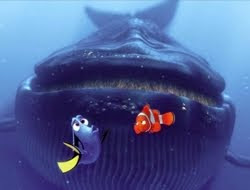
Meeting with the WhaleNext, I let them watch through the fishing boat capture. We equated the whale, gender undetermined, that swallows Dory and Marlin as "woman as temptress" because in Marlin's mind at least this experience takes him off the path of his adventure. The whale poses the danger of getting eaten on the one hand, but it is also a womb-like bubble of protection from the other uncertainties of the ocean. One very literal, not-so-bright student interjected that the whale scene was "belly of the whale," even though we had concluded that a different, much earlier part of the movie had already met that stage, even though I had carefully explained the stage as being swallowed into the great unknown. Alas, there's one in every class ...

For Marlin, "atonement with the father" is the most important stage. We concluded that Marlin's "father" was all of the permissive dads who allowed—in Marlin's mind at least—their children to have too much independence. At the start of the movie, Bob [the seahorse], Ted [the octopus], and Bill [the fish] come to mind; they easily relinquish their children to Mr. Ray, the schoolmaster. Marlin initially believes that these fathers are wrong to give their children so much freedom, but as a result of his adventures, he realizes that Crush and Dory are both right about trusting and letting go.

Marlin gets to demonstrate his "atonement with the father" during the next two stages, "apotheosis" and "the ultimate boon." When Dory is scooped up by the fishing boat, Nemo rushes to help her. Marlin, however, doesn't want to lose his son again and tries to interfere. Nemo insists that he can save Dory and explains that Marlin can help as well by getting all of the netted fish to swim down. Marlin relinquishes Nemo's fin, allowing his son to have independence, and then works to inspire the trapped and bewildered catch to swim together toward the ocean floor. Marlin demonstrates god-like ability as the catch overpower the humans who trapped them. Their eventual escape of the net qualifies as "the ultimate boon," the difficult task easily accomplished. I told my students to compare this Marlin to the pathetic version at the beginning of the movie. Pre-adventure, Marlin couldn't save Nemo from a tiny net; now, however, he nearly capsizes an entire fishing boat to free his son.

My students and I never observed Marlin refuse the trip home, but we could get him through the rest of the Return portion of the cycle. We decided that a couple of things could satisfy "magical flight." First, since ocean gossip about Marlin's search for Nemo helped our hero get to his son, then all the creatures who knew the story would help [or at least not hinder] his return to the reef. Since some students believed Dory was supernatural aid, equating her as a loopy Athena to Marlin's dysfunctional Odysseus, Dory could also be the divine aid maneuvering Marlin home. Even the pipe Marlin begins to follow, erected by otherworldly humans, could qualify.

"Rescue from without," that call from the old life to return, has existed the entire movie for Marlin. The reef, its comfort and familiarity, beckons him back. We knew Marlin crossed "the return threshold" because we saw him happily home at the end of the film.
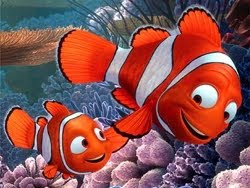
Marlin and NemoWe realized that the journey had certainly changed Marlin. Not only does he allow Nemo the independence to attend school, but that tight hold he had both on his son and himself [hence his inability to tell a successful joke] has loosened. Now he can deliver a flawless punchline and graciously welcomes Bruce, the fish-eating great white, who arrives to deliver Dory. The other reef dwellers, none of whom have taken as great an adventure, panic in the shark's presence, but Marlin, who is now "master of two worlds"—the reef and the open ocean—has no fear. He has "freedom to live," his worst personality flaw corrected during the arduous journey. Marlin has the knowledge and skill to swim past the drop off if a need ever arises. Should a paralyzed parent be unable to dash after a lost child, we know if Marlin is there, he will swoop up the fishlet and return the kid to the reef in Superman fashion.

I read the Joseph Campbell biography at Wikipedia and learned that several folks criticize his hero cycle. For example, Kurt Vonnegut says that it is better named the "in the hole" theory and can be summarized like this: "The hero gets into trouble. The hero gets out of trouble." A careful reading of The Hero with a Thousand Faces reveals that the cycle is more than "into trouble ... out of trouble." Several key stages in Initiation—"meeting with the goddess," "woman as temptress," and "atonement with the father"—and then demonstrating "master of two worlds" in Return are key to refining the hero's personality, fixing flaws that existed before the adventure began. We tend to believe that we "know it all," but hearing and accepting the advice of the goddess shows us that we don't have the full picture, opening us up to the wisdom of others. Navigating successfully past the temptress, who represents the pleasures and diversions of the flesh, allows us to experience the full strength of our own discipline and will. In "atonement with the father," when we see that we too are capable of what we despised or disagreed with, we realize that any two opposing sides have validity. We see that another's opinion is not a cause to argue, just a different "side" of the one universe, someone's wet to our dry, someone's cold to our hot, someone's salty to our sweet.

The cycle isn't a spring break road trip where the hero parties too much and then returns home unchanged. The cycle is instead an opportunity to evolve, the chance to develop an inner strength that makes the hero more adaptable to an ever-changing world. Neo in The Matrix is better able to maximize his potential as the result of his adventure, just as Marlin demonstrates at the end of Finding Nemo.

Thursday, March 9, 2006

Worrisome Grade Inflation or Good Teaching?

My friend Elizabeth chairs the academic grievance committee at school, so I usually hear a blow-by-blow description of the events that occur at the contentious meetings where students protest their grades. The question that the committee members always ask the instructor is this: Did you warn the student at midterm that he was failing? College policy states that faculty members must alert students in writing that they are not performing at a passing level. An email digitally stored on the college server—not a verbal warning or a message written on an assignment that the student has since conveniently "lost"—is the agreed upon best method. [I am old enough to remember the days when we had to fill out a paper form, look up where the student lived, and then address the envelope to send the warning. The student received the top white copy, the department got the yellow, and the faculty member kept the pink.]

To cover my ass To abide by college policy, this week I emailed all of my students in five classes, letting them know where they stood at midterm. I noticed an odd pattern in the averages. In the three sections of freshman composition [approximately 70 students], I gave three As total: 2 in one class, 1 in a second class, and 0 in the third. In the two research classes, however, I gave mostly As and Bs. The occasional C, D, or F was usually the result of missing work averaging as zeros, not poor performance on the assignments I had received. In short, my grade distribution makes me look like a real hard-ass in freshman composition but an easily pleased grade inflater in the research class. Neither label is accurate.

Part of the grade distribution disparity is the different types of students in the two courses. In the research classes, which have freshman composition as a prerequisite, the students are proven performers; they have all passed the department-graded, do-or-die final exam. The freshman composition classes, however, are mixed bags: preparatory and ESL students who barely squeaked through those programs before attempting college-level work, drop-outs from four-year schools who spent their first freshman year partying too much and studying too little, resentful repeaters who couldn't pass the department exam the previous semester, and decent writers with college-level placement scores. In the freshman composition classes, my department means business. Since my colleagues will flunk any bad writers at the final exam grading—resulting in those folks earning Fs as final grades—I must let students know all along the way if they aren't writing at a passing level. Harsh but fair evaluation from me tempers the students' disappointment and anger when their blue books don't get passing scores. They can't complain about failing the course when I have said over and over in the comments on their essays that they have serious writing problems they must fix by the semester's end.

The reality of the upcoming freshman composition final exam explains the lack of good grades in those sections, but how do I explain the typically high grades in the research classes? As an aside, the research classes often have a low completion rate; ending a semester with 12 of the original 25 students is typical for many professors because the long research essay so intimidates students that they withdraw. I, however, can usually get 23 or 24 of the students to hang on and finish. Is it because I inflate grades, allowing students to perform badly but still receive As and Bs? There's no department-graded exam to squash the poor performers and insure quality control as we have in freshman composition.

The answer of course is no. My research students succeed and finish because I have set up the course so that if they follow directions—i. e., do exactly as I say—they will not only write a real research essay, a document they would be proud to show anyone, but also have a good average at the end of the semester. Students typically produce crappy research essays because they have never really written one. Oh, sure, they have been assigned long research papers over and over again, but they procrastinate getting started, try to write the whole thing over a weekend or in a single night, bang out some total piece of crap [probably half plagiarized], and turn it in to satisfy the assignment. What occurs on those pages is so not a research essay. When I was in college, a professor would say, "A paper on X is due such-and-such a day," and then never mention the assignment again. I could handle that; I was a good enough writer. Many of my colleagues today take their cue from a similar college experience and do exactly the same thing here at the community college. They might take their classes over to the library for a tour; they might warn the students not to plagiarize or show them how to set up documentation. But my colleagues assume that students have a plan for their papers, even though the final products they receive demonstrate over and over the faultiness of that assumption. One member of my department, so frustrated by the quality of work her students produce and so unwilling to change the way she does things, has decided that this semester's research class will be the last one she ever teaches, by god.

For many years I refused to teach the research class. I had seen too many disastrous efforts students had written for other instructors and decided hell would freeze before I was going to read a whole set of that crap from my own people. Then I decided that there must be a strategy to get them to write good research essays. They could write perfectly decent short papers in freshman composition, so where did their fuses blow in the transition from short to long? I realized that it must be right at the beginning, when the professor said, "I need an X-page [or Y-word] research paper on _____." The greater length and necessity of research paralyzed them because they didn't have a plan. They waited until the last minute because they didn't know where or how to start. They didn't start until complete desperation descended on them the night before the thing was due.

I realized that if I wanted students to write successful, long research essays, ones that I wouldn't mind reading, I had to provide the plan. This doesn't mean that I give them a specific topic. Rather, I demonstrate the stages—everything from choosing the topic, to deciding the logical flow of the project, to ensuring that in-text citations in the final draft flawlessly match the entries on the works cited page. We write the essay in a non-negotiable series of steps, everyone producing a similar new piece for the paper, no matter how divergent the topics are. Because the students are writing little pieces that we knit together, it doesn't matter if they produce the pieces at the last minute; the assignments are so small that even the last minute gives them enough time to write a decent effort [and thus earn a decent grade]. We all do the research together. For example, on one day, two database article summaries are due. One student's summaries might chronicle the advancements in prosthetic devices while another student's summaries document the efforts to preserve the Great Barrier Reef in Australia or the advantages of maggot therapy for diabetes patients with necrotic tissue.

Providing the plan—the formula or recipe for the essay—means more work for me, and more grading as well. Instead of one paper worth 25, 30, or even 50 percent of the course grade, I read 12 different assignments, the last one the final draft. But because I have seen the 11 pieces produced before the final product, because I have actively guided students so that the final draft has a logical flow and all the components of a real, correct research essay, the papers are pretty good. As a result, I can give those papers good grades, contributing to my students' successful averages. If the students remember for future papers that the key is little pieces stitched together to make the longer effort, they then have the skill to produce real research essays for professors who just announce the assignment and due date and never mention the paper again.

Am I mollycoddling my students? Maybe. But I have good papers to read at the end, and I'm not complaining to my colleagues that students can't write. If a student completely mishandles a short piece, I read 300-400 bad words, show that person what to correct, and can usually expect the next piece she produces to meet my expectations. We have more fun, everyone preparing the same short piece on wildly different topics. Student morale is high because they see both themselves and the rest of the class getting through the arduous course requirement rather than watching their classmates disappear one by one as they realize they can't complete a long paper without a plan. Do I worry that I give too many As, too many Bs? Not really. This is one class where I can clearly communicate what each piece must contain, and since the students are proven writers, they have the capability to do the work. Will the majority of my colleagues follow suit? No way. They are too convinced that they are single-handedly enforcing the only real standards on campus to try something that might allow everyone to succeed [not just the handful of really bright students]. In addition, they're too busy complaining about the horribly prepared students in their classes to have time to rethink their pedagogy and try something new.

Thursday, February 23, 2006

Inevitable

Each semester I have one class that is my "unfavorite." This time, the dislike I feel is far greater than usual. For a really stupid reason, I agreed to teach a section of freshman composition at 7 a.m. My dean passed out spring term schedules at a department meeting I neglected to attend, and when I found mine in my mailbox the next day, I felt that I couldn't complain as I had intentionally missed the meeting. I didn't want to compound the bad karma, so I decided to suck it up and teach at that early hour.

The class wasn't a punishment. I happily teach at 8 a.m., but this semester the college abolished that start time, which means classes now begin either at 7 or 8:30. Connie moved what would have been my 8 a.m. class to 7 a.m., probably because I have never complained about the 7 a.m. class I always teach during one of the summer's short semesters. Getting up at 4:30 is fine for five short weeks, 20 class meetings total. But during a 15-week semester, it's hell. I have to reset the alarm every evening because my Monday/Wednesday schedule doesn't require leaving the house as early. Sometimes I wake up in the middle of the night and can't remember if the next morning is a Tuesday or Thursday, which means I must get out of bed to confirm the day and correct alarm time. I leave the house in the pitch dark, hoping I don't miss a stair and crack my head open on the front sidewalk, and then get to play "Near Miss" with the drunks who are still on the road.

But I am a professional, so my attitude is the same for the 7 o'clock group as it is for my later classes. I don't bitch about the time, just get down to business. Although I am awake and fully functioning, many of the students are not. Two distinct personalities comprise the class: the mature, responsible folks who registered for a 7 a.m. class because that time fits their schedule, and then everyone else who was "forced" to take it because no other section remained open. In this last group, I have the lifelong procrastinators, the slackers, the oversleepers. I passed back a quiz today: 9 students earned As; two not-so-bright hardworkers got Cs; the other half of the class made Ds and Fs. The line of demarcation is clear.

Now I am not about to start complaining that malcontents are walking in late. I don't allow students to disrupt the rest of us with their tardiness, so they are in class on time but resentful. And I'm not going to whine that they are sleeping either. They get one polite warning after the class they slept through [I'm not a fan of public humiliation]; then I just mark them absent and eventually withdraw them for "nonattendance." I guess my dislike for this group is the high number of students with crappy attitudes. Every class has a handful of poor performers. But I am a really good teacher, usually maintain everyone's attention with interesting and meaningful material [no small-group bullshit or in-class busy work], and the handful of slackers who do register for a class with me either get peer pressured into becoming at least decent students or withdraw.

Fifty percent of this 7 a.m. class, however, doesn't want to learn. I am trying to ignore their presence, their palpable dislike for everything we do, their sad attempts to look awake while they zone out, for the other half of the room includes people who have their notebooks open before I arrive and are attempting to become better writers. But I am finding it hard to keep my focus on the good students. I am used to enthusiastic people concerned about the course content [or at least their good grades], so half a class of malcontents who shrug indifferently at yet another D or F is really getting on my nerves. There is an unspoken tension in the room between those who are "too cool for school," who look on disdainfully at anyone who bothers to take notes, for example, and everyone else.

I'm really at a loss as to what I should do. I imagine that as the weather warms, they will drop like flies, preferring a trip to the beach or an extra hour in bed to their complete boredom in my class. I am used to finishing with most of the students who start the semester, but this group of losers can't withdraw soon enough, no matter what lousy retention numbers I have at the end of April.

Today officially marks the halfway point, the end of week 7 in 14 weeks of instruction. I have 14 more energy-sucking mornings before I never have to see this particular sea of faces again. When I spot these students as individuals in the hallway, I will regret that the good ones didn't have the typical Professor Lightbulb experience that is my reputation. I will ignore the glares from the slackers who have had to re-register for the same course because they failed their first attempt with me.

Damn, I wish I hadn't missed that department meeting so that I could have wailed to Connie that there was just no way I could teach at 7 a.m. during a long semester!

Saturday, February 18, 2006

The Return of the Bugs

Green Eyes
I drove to Leu Gardens today, not expecting to find much to shoot for the photoblog. Taking the camera out and not finding any insects, my subject of choice, has become very depressing. Plus, I feel some pressure to perform as the photoblog has several loyal viewers [unlike this word blog which no one but Elizabeth reads]. We had record lows in the 30s earlier in the week, so I assumed the cold had wiped out the few slow and tattered insects that had lived through the winter. I started down at the lake, hoping to find an interesting bird willing to pose, but the reeds and beach were empty.

As I was heading back to the gardens proper, I caught a flash of silver. A lacewing, perhaps? I walked over to investigate and realized that it was a dragonfly, from the look of her [the coloring indicates a female Eastern pondhawk], a newly emerged one. She had pristine wings—not a single tattered edge—and acted as if this body were a foreign language she didn't yet understand. She stayed close to the ground, making frequent stops in the cut grass. A mockingbird had his eye on her, but I shooed him away, and with the new lens [a 300 mm] got a few very nice close ups. The lake edges have been dragonfly free for quite some time, so her presence must mean that spring is indeed near.

I spied a skipper butterfly in the "home demonstration" garden and then went in pursuit of a fat bumble bee. That's when I learned that my camera battery had died [this new lens, with image stabilization, sucks down a battery much more quickly than I'm used to], so I headed home. But at least the bugs are returning!